Cartridge Heater Selection: Watt Density, Fit and Lead Options
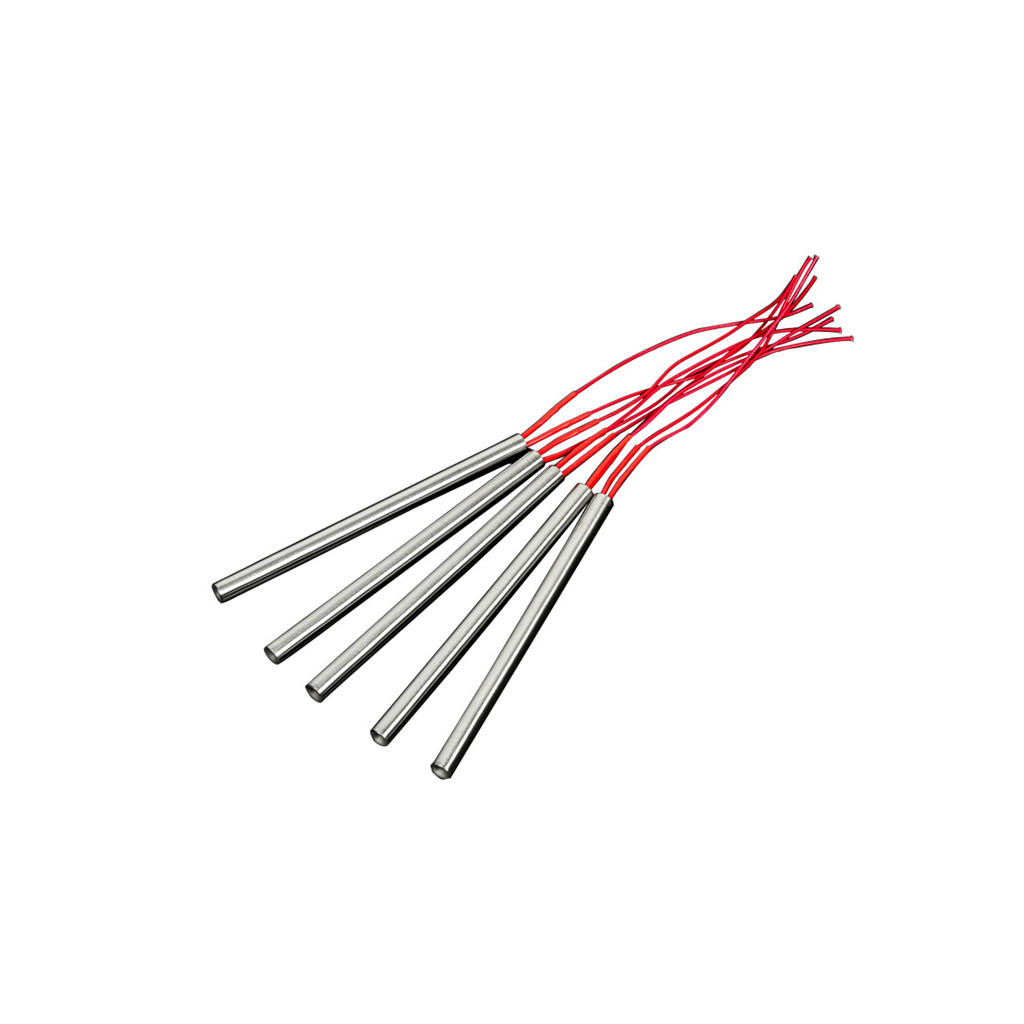
A cartridge heater is a compact resistance element inside a metal sheath, inserted into a drilled bore in a mould, platen or hot runner. It looks like a commodity part. In practice, most premature failures come from three specification mistakes made at the ordering stage: too much wattage for the surface area, too loose a fit in the bore, and the wrong lead exit for the installation.
Watt density is the number that matters
Watt density is the heater's power divided by its heated sheath surface area, usually expressed in W/cm² (or W/in²). It describes how hard the element has to push heat through the sheath into the surrounding metal. A high watt density is fine in a tightly fitted steel mould that conducts heat away quickly; the same heater running in air or in a loose bore will overheat and burn out.
There is no universal 'safe' value — acceptable density depends on the sheath material, the bore fit, the operating temperature and how fast the load absorbs heat. As a rule, start from the required wattage, then check the resulting density against the supplier's recommendation for your operating temperature.
Calculate the wattage you actually need
Break the load into three parts:
- Heat-up energy — mass × specific heat × temperature rise, divided by the desired heat-up time.
- Steady-state losses — conduction to adjacent parts, convection and radiation from exposed surfaces.
- Process load — material being melted, heated or dried.
Add a reasonable design margin for voltage variation and ageing, but avoid oversizing 'to be safe'. An oversized heater short-cycles, which stresses both the element and the controller. If the calculation is uncertain, tell your supplier the block material, mass, target temperature and heat-up time and ask them to size it.
Bore fit: the silent killer
Heat leaves the sheath through the tiny air gap around it, and air is an insulator. A few tenths of a millimetre of clearance can raise element temperature dramatically. Specify the bore diameter together with the heater diameter so the two are matched as a pair, keep the bore clean and round, and consider a swaged or tightly toleranced heater for high watt density work. Avoid stacking heaters in a bore that was drilled for one.
Also check insertion depth: an unheated length left outside the block is not wasted, but a heated length protruding into air is a guaranteed failure point.
Sheath, leads and sensors
- Sheath material — stainless steel suits most moulds and platens; Incoloy or other alloys are used at higher temperatures or in corrosive environments.
- Lead exit — straight leads, right-angle leads, braided stainless protection, conduit or a terminal box, chosen for the cable routing and bending radius in the machine.
- Built-in thermocouple — type J or K located at the hot zone gives far better control than a sensor elsewhere in the block.
- Sealing — specify a moisture-resistant seal where the environment is humid or the part is washed down.
Common failure modes
Open circuit from an overheated element, insulation breakdown from moisture ingress, lead damage from repeated flexing, and sheath corrosion are the four usual suspects. When a heater fails early, photograph the sheath: a localised burn mark points to a poor bore fit or an air gap, while uniform oxidation points to excessive watt density or loss of control.
Frequently asked questions
Can a cartridge heater be shortened or bent?
Not in the field. The internal coil and the unheated end are engineered for a specific length, and bending damages the ceramic insulation and the sheath seal. Order the exact length and lead configuration for the drawing.
Why does my heater burn out even though the wattage seems low?
In most cases the heater is not the problem — the fit is. A loose or dirty bore traps air, so the element runs far hotter than the block. Check bore diameter, surface finish and insertion depth first.
Do you supply custom diameters and built-in thermocouples?
Yes. Diameter, length, wattage, voltage, sheath material, lead type, mounting flange and integrated thermocouple can all be specified per drawing. Send the bore dimensions and working temperature when requesting a quote.