Mica Band Heaters for Injection Molding: Sizing, Installation and Failures
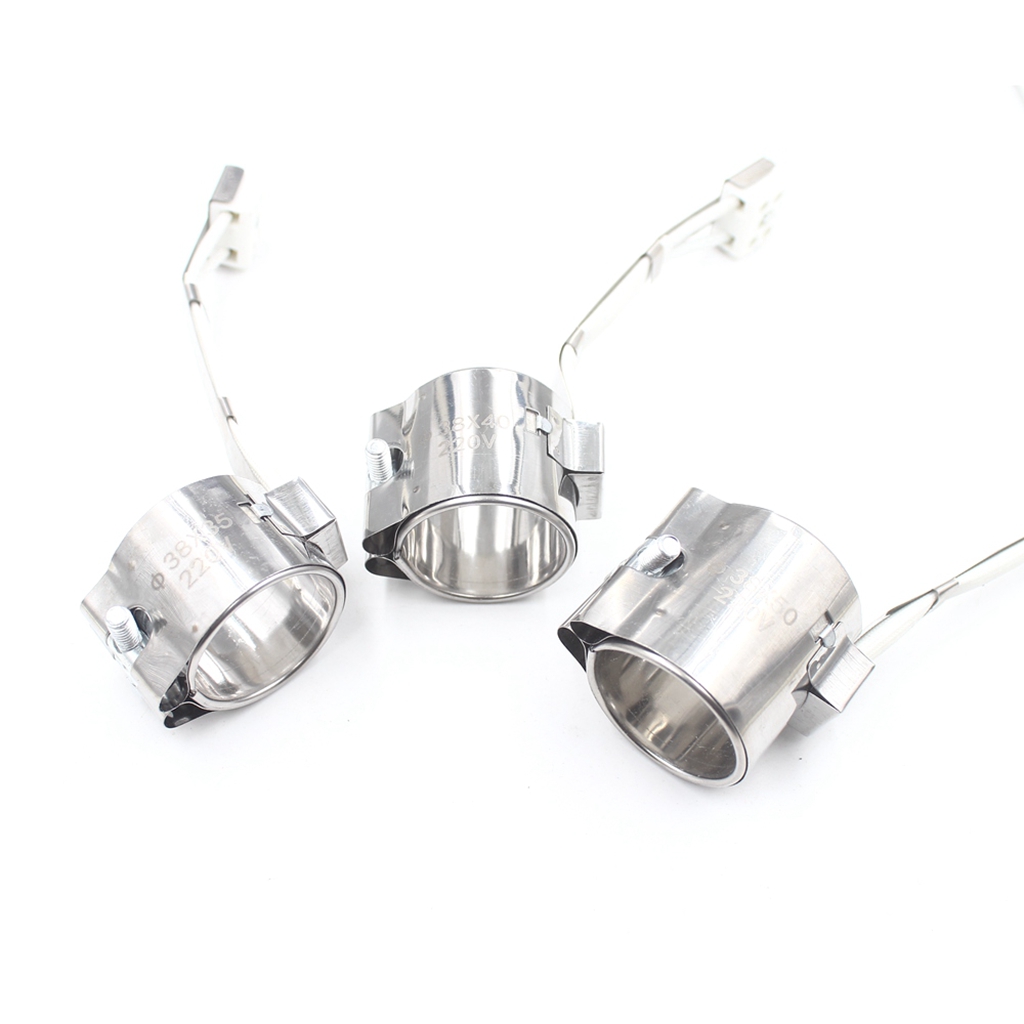
Mica band heaters clamp around a nozzle or barrel and conduct heat inward through their stainless steel sheath. They are inexpensive, easy to replace and available in almost any diameter — which is why they are the default on injection molding machines. It is also why they are often specified casually and then fail early.
Specify the band as a mating part
A band heater must match the barrel it wraps. Record the exact inside diameter (measure the barrel, not the old heater), the band width, the available axial space, and where the leads and any thermocouple need to exit. Also note whether the band must be split into two halves to install over an existing assembly, and whether a hole or cut-out is needed for a sensor or nozzle.
Wattage should follow the surface area of the band and the process temperature, not simply 'the biggest available'. More wattage in the same footprint means higher surface loading and a shorter element life.
Installation is mostly about contact
Clean the barrel surface of old carbonised residue, then fit the band and tighten the clamping strap evenly. Any gap between sheath and barrel becomes an insulating air pocket; the element behind that gap overheats and eventually opens. Do not hammer a band into shape, do not re-use a distorted clamping bolt, and keep the lead exit away from molten material and moving parts.
After the first heat cycle, re-check the clamp tension once the assembly has expanded and settled — a band that was tight cold can be loose hot, or vice versa. Place the control thermocouple in the barrel metal near the band rather than on the outer sheath, which reads cooler than the process.
Reading the failure
- Localised burn or a hole in the sheath — poor contact or an air gap at that point.
- Uniform dark oxidation and brittleness — chronic overheating or excessive watt density.
- Lead failure at the exit — vibration, repeated bending or plastic ingress; specify a protected exit.
- Frequent cycling and slow heat-up — a badly placed sensor or a controller that needs tuning.
When to upgrade
If a band at a given station fails repeatedly despite correct installation, the process may have outgrown the technology. Cast aluminum heaters with a liquid-cooled or finned design provide more uniform temperature and better mechanical life on demanding extruder barrels, while ceramic-insulated bands run hotter with lower losses. The decision is usually driven by temperature uniformity and downtime cost rather than the price of the heater itself.
Frequently asked questions
Can I reuse a mica band heater after removing it?
Usually not recommended. Once a band has been heated and formed to a barrel, removing and refitting it often distorts the sheath and breaks the contact fit. Bands are consumables — keep spares for critical stations.
How do I measure the inside diameter correctly?
Measure the barrel outside diameter with a caliper at the exact axial position where the band sits, at room temperature. Do not measure the inside of a used heater, which has been deformed by clamping and heating.
Can a band heater include a built-in thermocouple?
Yes, but for process control a sensor in the barrel metal is generally more accurate. Discuss the sensor position when specifying the band so a cut-out is provided if needed.